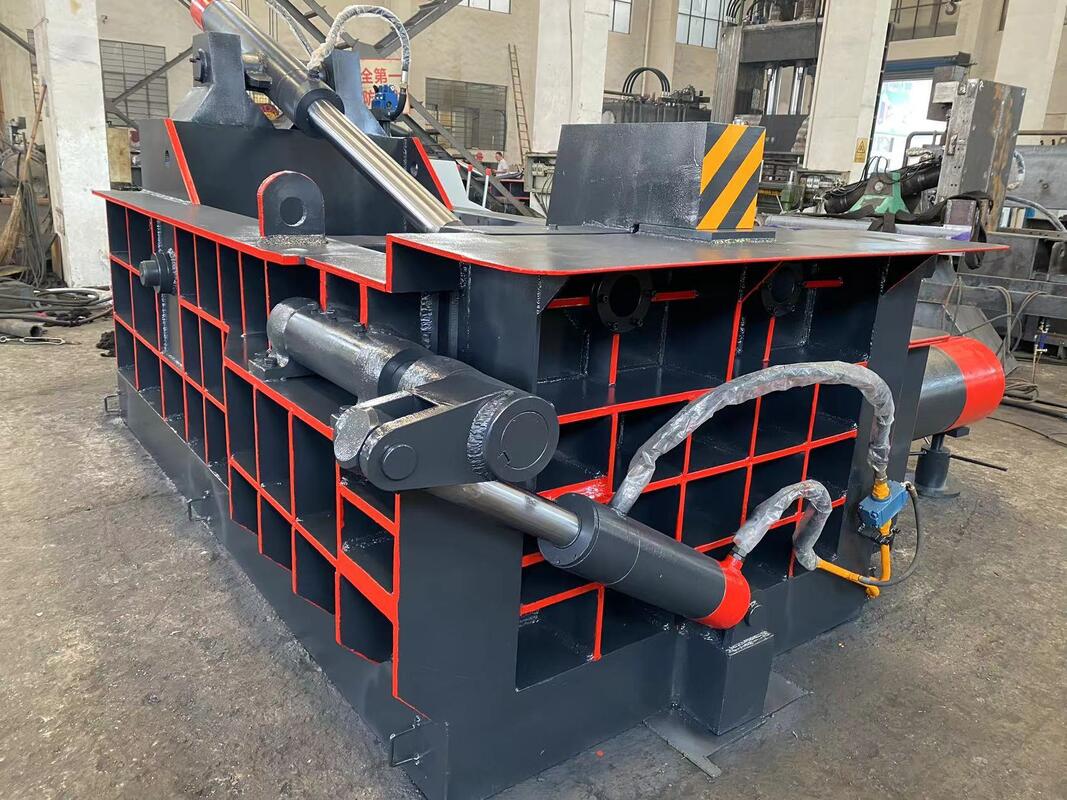
| الاسم التجاري: | HUAKE |
| رقم الموديل: | Y81-315 |
| موك: | 1 مجموعة |
| السعر: | 20000-50000 USD |
| موعد التسليم: | 35-40 يومًا |
| شروط الدفع: | الاعتماد المستندي، تي/تي |
The Y81F-315B is a hydraulic scrap metal baler designed for operations that need measurable compression output and a defined bale section. The specification sheet lists a production rate of 5–8 tons per hour, supported by a 3150 kN main compression force, dual 45 kW motors, and a material box size of 2000 × 1750 × 1200 mm. These values make it suitable for SEO content focused on operating capability rather than only on tonnage class.
The source file also includes working images showing pressing and bale turn-out, which helps this page version align with process-oriented buying intent.
This page angle works best for recycling and scrap handling businesses that compare balers through expected hourly output, chamber size, and workflow visibility. The published production rate gives a stronger operational anchor than broad claims such as “high efficiency.”
The bale photos and shipment references also make this version useful for pages that need to connect shop-floor use with delivery planning.
The machine is listed with a production rate of 5–8 tons per hour, which is the central operating number for this version.
The 2000 × 1750 × 1200 mm material box and 600 × 600 mm bale size help explain how the machine translates chamber capacity into regular output format.
The machine uses 45 kW × 2 motors and 31.5 MPa × 2 hydraulic pumps, giving the hourly-output figure a technical support structure.
Pages 4 and 5 show pressing and bale turn-out, which makes it easier to support operational messaging with visual process references.
Scrap is loaded into the material box and compressed through the hydraulic cylinder system until it reaches the target bale section. The machine then completes bale discharge through its door-cylinder arrangement. The PDF’s image sequence shows the baling process during compression and after bale turn-out, which aligns with the listed machine components.
The output-oriented reading of the specification comes from combining chamber size, drive configuration, hydraulic rating, and the published 5–8 tons/hour production figure.
Choose this machine if your first comparison question is how much material the baler can process within a working hour. In that case, the most relevant values are the published 5–8 tons/hour rate, the chamber size, and the power-plus-hydraulic configuration behind that figure.
If your project depends more on shipping footprint or hydraulic pressure class than on stated hourly rate, another page focus may be more effective.
A frequent problem in scrap operations is that equipment descriptions emphasize force but say little about actual working pace. This machine addresses that by publishing a 5–8 tons/hour production rate along with the component data that supports it.
It also helps content teams avoid vague “fast operation” language because the PDF already provides a measurable hourly output reference.
The PDF states 5–8 tons per hour.
It is 2000 × 1750 × 1200 mm.
The bale size is 600 × 600 mm.
The machine uses two 45 kW motors and two 31.5 MPa hydraulic pumps.
Yes. The PDF includes pressing and bale turn-out images on later pages.
The Y81F-315B hydraulic scrap metal baler is a 315-ton class machine designed not only around compression performance but also around project delivery practicality. In addition to core machine parameters such as 3150 kN main thrust, 45 kW × 2 motors, and 31.5 MPa hydraulic pumps, the PDF also includes a defined dismantled shipment plan. That makes this version especially useful for buyers who consider installation logistics early in procurement.
The source file specifies shipment space as 1 × 20 FR flat rack plus 1 × 20 ft regular container, which gives the page a real logistics angle beyond general machine description.
This page version is suited for export-oriented equipment projects, overseas scrap yard installations, and procurement teams that need both machine data and shipping references in one place. The PDF even includes shipment photos and notes that similar 315-ton pressure machines were shipped to Malaysia.
It works well for pages targeting buyers who want to understand not only what the baler does, but also how it is likely to be delivered.
The file states 1 × 20 FR (over wide) flat rack part plus 1 × 20 feet regular container. This is a strong operational detail for export-oriented buyers.
The flat rack part is listed at 2.8 m W × 5.4 m L × 2.2 m H, with a weight of 24 tons. The regular-container part is listed at 7 tons.
Shipment planning does not replace the machine’s core data. The baler still centers on 3150 kN main thrust, two 45 kW motors, and 31.5 MPa pumps.
Pages 6 and 8 show dismantled transport and container loading, which can support a shipment or delivery section on the site.
From an operating standpoint, the machine compresses loose scrap inside the 2000 × 1750 × 1200 mm material box and forms a 600 × 600 mm bale section through its hydraulic cylinder system. From a project-delivery standpoint, the machine is dismantled into transportable parts for flat-rack and regular-container shipment, as shown in the PDF.
This dual reading of the machine—working process plus shipment process—makes the page more practical for overseas project buyers.
Choose this model when shipping method, installation planning, and overseas delivery feasibility are part of the early buying process. The presence of published transport dimensions and loading photos can reduce uncertainty during project evaluation.
If your comparison is purely based on hydraulic force or hourly output, another content angle may be more direct. If your buyer is thinking about both machine performance and export logistics, this version is stronger.
One practical problem in industrial procurement is that a machine may look suitable on paper but provide no shipment detail. This baler solves that gap by including not only compression and power data, but also a defined shipment breakdown with dimensions, weights, and image references.
That makes it easier for buyers to move from machine evaluation to transport planning without needing to infer basic logistics information.
The PDF lists 1 × 20 FR flat rack plus 1 × 20 ft regular container.
The flat rack part is listed as 2.8 m W × 5.4 m L × 2.2 m H.
The flat rack part weight is listed as 24 tons.
The regular-container part is listed at 7 tons.
Yes. The PDF includes shipment and container-loading images on the later pages.
| Model | Main Cyl.Force (ton) |
Press Box Size (mm) |
Bale Size (mm) |
Bale Weight (kg) |
Motor (kW) |
| Y8FT-315A | 315 | 2000x1750x1000 | 500x600 | 300-500 | 2x45 |
| Y81F-315B | 315 | 2500x2000x1200 | 600x600 | 400-700 | 2x45 |
| Y81F-315E | 315 | 2500x2000x1200 | 600x600 | 400-700 | 2x45 |